
This post contains affiliate links, meaning I may earn a commission if you click through and make a purchase. As an Amazon associate, I earn from qualifying purchases. This comes at no additional cost to you. I only recommend products or services that I believe will provide value to my readers based on personal experience or thorough research.
Most people think storyboarding is about planning. It’s not. It’s about exposure.
The moment you try to draw your idea—even as three ugly boxes—it stops hiding. Weak ideas collapse. Confusing ideas tangle themselves. Empty ideas suddenly feel loud and awkward on the page.
Storyboarding isn’t a tool. It’s a lie detector. If your story only works in your head, that’s not a story. That’s a vibe. And vibes don’t survive contact with reality.
Three Boxes Tell the Truth
You don’t need talent to storyboard. You need honesty.
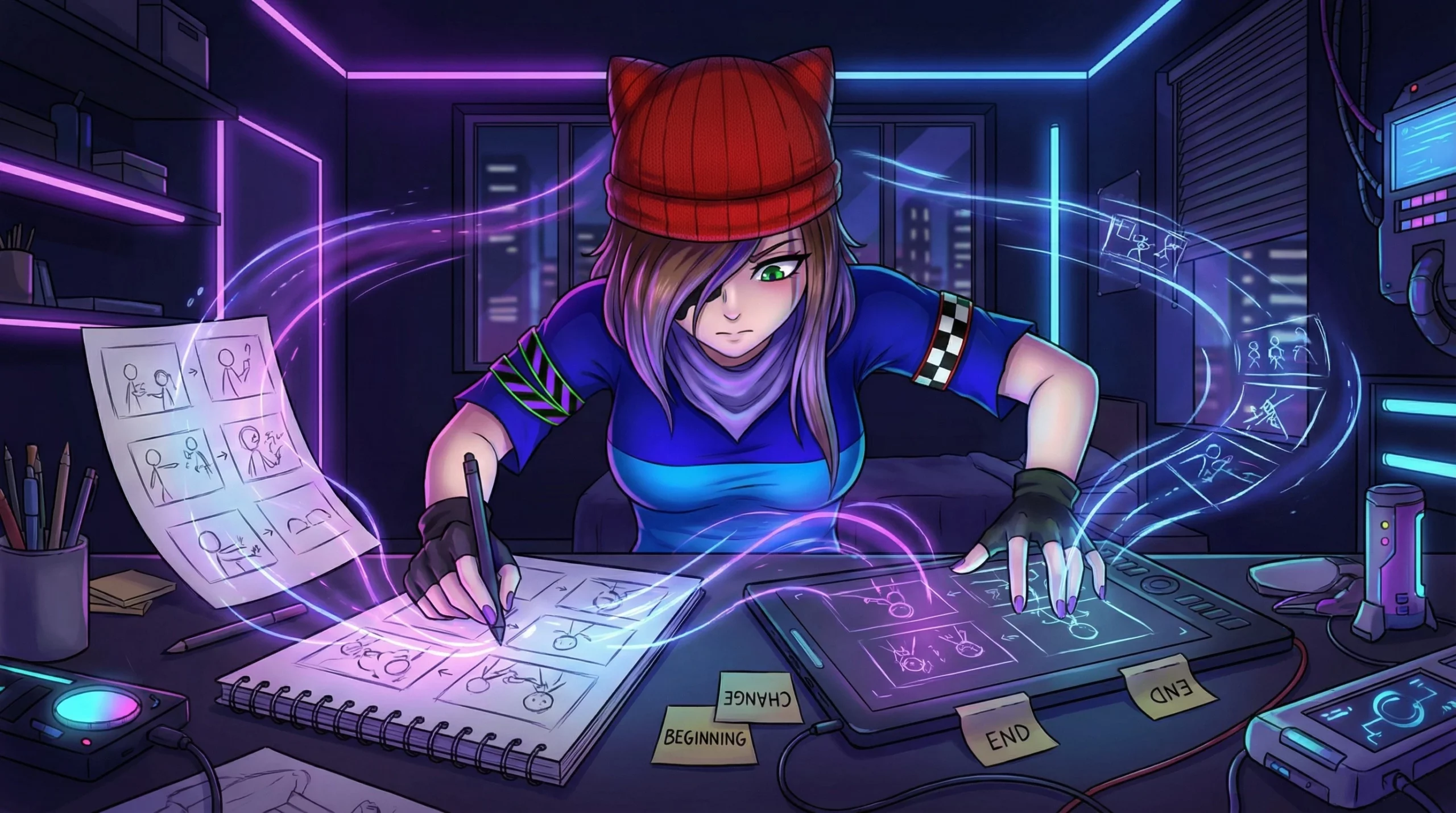
Take any idea you think is “good.” Now draw three frames:
1. What starts it
2. What changes
3. What ends
If you freeze, the problem isn’t your drawing. It’s your thinking.
People hide behind detail. But when you strip it down to three moments, there’s nowhere to hide. Either something happens—or it doesn’t.
Detail Is Often a Disguise
Beginners think detail equals depth. It doesn’t.
Detail is often what you use when the core is weak.
If you need ten panels to explain what one moment means, the moment isn’t clear. If you need notes to explain emotion, the emotion isn’t working. If you need dialogue to carry the scene, the scene has no spine.
Strong ideas survive being drawn badly. Weak ideas need to be dressed up.
Storyboarding Exposes Pacing
When you draw your idea, time becomes visible.
You see where nothing is happening, where too much is happening, where emotion is rushed, and where tension never forms.
In your head, everything feels dramatic. On paper, most of it feels empty.
That’s not failure. That’s information.
The Beginner Trap: Making It “Look Right”
New creators focus on making boards look good. Wrong goal.
Your storyboard should be ugly and honest, not pretty and fake. Messy lines are fine. Stick figures are fine. Confusing boxes are fine.
What’s not fine is hiding confusion behind style.
If you don’t know what’s happening in your own frame, no one else will either.
Storyboards Don’t Build Stories — They Reveal Them
You don’t use storyboards to invent meaning. You use them to test whether meaning already exists.
They show you what you understand, what you’re pretending to understand, and what only works because you’re being generous to yourself.
The page is not kind. It doesn’t assume. It doesn’t fill gaps. It just shows what’s there.
The Real Skill Isn’t Drawing — It’s Seeing
Storyboarding trains one thing above all: the ability to look at your own idea and say, “No. That doesn’t work.”
Not because someone told you—because you can see it fail.
That’s the shift. Not learning how to storyboard—learning how to stop lying to yourself about your ideas.
FAQs: Storyboarding as a Thinking Tool
What is storyboarding really for?
It exposes whether your idea actually makes sense when turned into images.
Do I need to draw well to storyboard?
No. If the idea works, it survives ugly sketches.
Why does my idea feel good in my head but fail on paper?
Your brain auto-fills gaps. Paper doesn’t.
How many panels should a beginner use?
Start with three: beginning, change, end.
What does storyboarding teach beginners?
Clarity, pacing, and honesty.
Why do my storyboards feel boring?
Because nothing is changing.
Is storyboarding only for animation or film?
No. It works anywhere ideas move through time.
What’s the biggest beginner mistake?
Making it look good instead of making it make sense.
How does storyboarding improve creativity?
It replaces fantasy thinking with visual truth.
When should I storyboard an idea?
As soon as you think it’s “good.” That’s when it’s most likely lying to you.


Leave a Reply